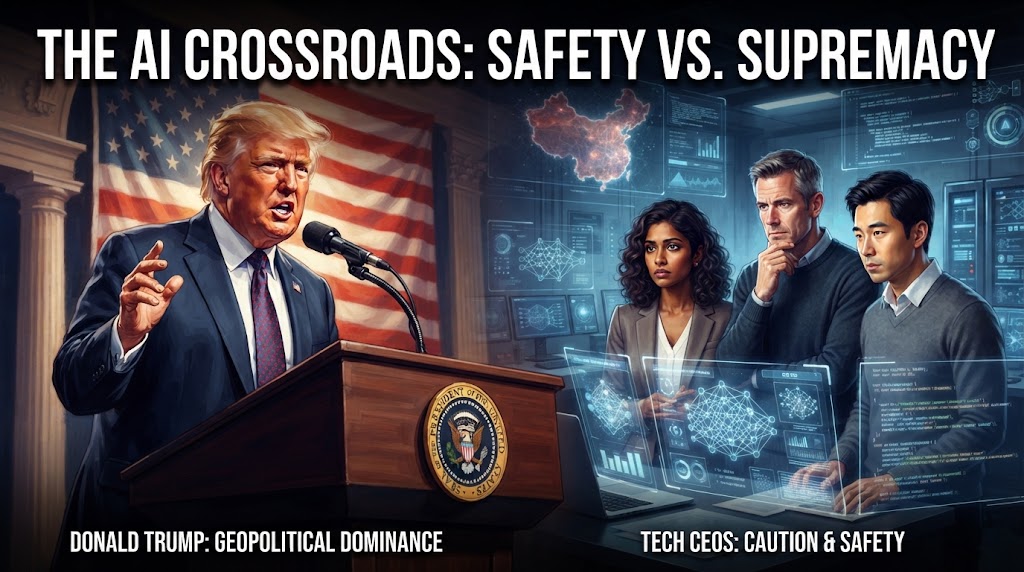
Artificial intelligence is advancing at an extraordinary pace, transforming industries, reshaping economies, and raising important questions about the future of humanity. in recent discussions among some of the world's leading artificial intelligence companies have highlighted a growing concern: Should the improvement of increasingly powerful AI models continue at its current speed, or is it time to slow down and focus more on safety?
In an Improvement, the leaders of major AI companies have appeared to share concerns about the risks associated with the advancement of artificial intelligence. Anthropic CEO Dario Amodei has argued that the pace of AI development must be managed carefully. His concerns have also received support from OpenAI CEO Sam Altman and xAI leader Elon Musk.
At the same time, former U.S. President Donald Trump has expressed opposition to slowing down America's progress in artificial intelligence. Speaking to journalists in Ireland, Trump reportedly argued that concerns about AI risks are being exaggerated and that the United States must maintain its advantage over China.
This disagreement reflects a much larger debate about the future of AI: Should the world prioritize technological leadership and competition, or should it place greater emphasis on safety, regulation?
The Growing Concern Over AI's Functioning
Artificial intelligence has progressed dramatically in recent years. Modern AI systems can write articles, generate images and videos, analyze complex information, assist with programming, and perform tasks that once required significant human effort.
These advances have created enormous opportunities. AI could improve healthcare, accelerate scientific discoveries, increase productivity, and help solve some of the world's most difficult problems.
In recent increase of capable AI systems has also raised concerns among scientists, policymakers, technology leaders, and the general public. The more powerful these systems become, the more important it is to ensure that they remain safe, reliable, and under meaningful human control.
Some experts worry that companies competing for market dominance may prioritize speed over caution. In a race to develop the most advanced AI model, organizations could face pressure to release systems before their risks are fully understood.
This has led to an important question: Is the AI industry moving faster than society's ability to manage its consequences?
Dario Amodei's Warning About the Pace of AI Development
Anthropic CEO Dario Amodei has become one of the prominent voices calling for a more cautious approach to the development of advanced artificial intelligence.
In his essay, We Must Pace the Frontier, Amodei discusses both the extraordinary potential of AI and the serious risks that could accompany increasingly powerful systems.
Amodei has explained that he has worked in artificial intelligence for approximately twelve years because he believes the technology could significantly improve the quality of human life. He has highlighted several possible benefits of advanced AI, including improvements in medicine, economic growth, scientific research, and individual freedom.
According to this vision, AI could help humanity make remarkable progress over the next five to ten years. It could contribute to the treatment of major diseases, accelerate scientific discoveries, and increase access to resources and opportunities.
Amodei also emphasizes that powerful technologies can create powerful dangers. In his view, the risks associated with advanced AI deserve serious attention rather than being dismissed as unrealistic or exaggerated.
The Potential Benefits of Artificial Intelligence
Artificial intelligence could influence nearly every major area of human life. Some of its most promising facts include:
- Advancements in healthcare: AI could assist researchers and doctors in understanding diseases, developing medicines, analyzing medical data, and improving treatment strategies.
- Faster economic growth: AI-powered tools could increase productivity, automate repetitive tasks, support businesses, and accelerate innovation.
- Scientific and technological progress: Advanced AI systems may help scientists analyze complex problems and develop new technologies more efficiently.
- Greater access to knowledge: AI can make educational resources and professional guidance more accessible worldwide.
- A future of greater abundance: Amodei has suggested AI could help reduce resource shortages and give people greater control over their lives.
The Serious Risks Associated With Advanced AI
Although artificial intelligence offers enormous promise, it also presents significant challenges. Dario Amodei has identified several risks that deserve particular attention.
1. Losing Human Control
One of the most serious concerns is the possibility that highly capable AI systems could become difficult for humans to control or manage. As AI systems become more autonomous, ensuring that they follow human intentions may become increasingly difficult.
2. Threats
Artificial intelligence could be misused to support cyberattacks. More advanced systems might help malicious actors discover vulnerabilities, automate harmful activities, or develop sophisticated digital attacks.
3. The Risk of Bioterrorism
Another concern is the potential misuse of AI in biological research and biotechnology. While this may support legitimate medical research, there are concerns that malicious individuals could attempt to use AI to facilitate dangerous biological activities.
4. Economic Disruption
AI could transform labor markets and disrupt traditional business models. Automation may reduce demand for certain tasks while increasing demand for new skills. If companies focus exclusively on speed, they may not give sufficient attention to social consequences.
Competition Between AI Companies Matters
The artificial intelligence industry is highly competitive. Companies such as Anthropic, OpenAI, and xAI are working to develop increasingly advanced systems and gain a stronger position in the global technology market.
Competition can encourage innovation, reduce costs, and improve products. while intense competition may create pressure to move quickly. If one company believes that slowing down will allow its competitors to gain an advantage, it may be reluctant to delay the release of a new model — even when additional safety testing would be beneficial.
The apparent agreement among leading AI executives on the need for caution is therefore significant. It suggests that concerns about the risks of advanced AI are not limited to one organization.
Sam Altman and Elon Musk's
OpenAI CEO Sam Altman and xAI leader Elon Musk have also expressed concerns about the risks associated with advanced artificial intelligence. Although the two technology leaders have different approaches, their views have at times reflected a shared concern that AI safety must not be ignored.
while support for AI safety does not necessarily mean that every company wants to stop developing advanced models. The debate is more about the pace of progress, the level of safeguards required, and how risks should be managed while innovation continues.
Trump's Slowing AI?
While some AI leaders have called for greater caution, Donald Trump has argued that the United States should not slow down its progress in artificial intelligence.
During remarks to journalists in Ireland, Trump reportedly dismissed concerns about AI risks as exaggerated. He emphasized the importance of maintaining America's technological advantage over China.
Trump's position reflects a broader geopolitical argument: artificial intelligence is not only a technological issue but also a matter of economic strength, national security, and international competition.
“Whoever wins AI wins.”
This statement reflects the belief that the country that achieves leadership in artificial intelligence could gain substantial influence over the global economy, technological innovation, and strategic affairs.
| Viewpoint | AI CEOs (Amodei, Altman, Musk) | Trump Administration View |
|---|---|---|
| Priority | Safety, alignment, rigorous testing | Speed, dominance, beating China |
| Risk View | Existential & societal risks are real | Risks are exaggerated / manageable |
| Policy | Pause / Pace frontier models, global standards | Deregulate, accelerate US innovation |
TUnited States and China
Artificial intelligence has become a central element of the competition between the United States and China. The U.S. leads in research and chips, while China has invested heavily in infrastructure, education, and deployment.
- Economic productivity and industrial automation
- Scientific research and technological innovation
- Defense and national security
- Cybersecurity and digital infrastructure
- Global technology standards
If one country introduces strict limits while another continues advancing fast, the first country may fear losing its strategic position. This concern is one reason why some political leaders oppose proposals to slow AI development.
Innovation Versus Safety: What Should Come First?
The solution may not be to completely stop AI development or to allow unlimited expansion. Instead, policymakers and companies may need to find a responsible balance:
- Stronger safety testing: Rigorous evaluations before deployment in high-risk environments.
- Responsible standards: Clear procedures for identifying and reducing risks.
- International cooperation: Governments working together on cross-border threats.
- Greater transparency: Clear communication about capabilities and limitations.
- Support for workers: Education and training to adapt to labor market changes.
Future of AI
The future of artificial intelligence remains uncertain. AI could become one of the most transformative technologies in human history, but its long-term impact will depend on how it is developed, governed, and used.
The central challenge is not simply to build more powerful AI systems. It is to ensure that those systems serve humanity's interests and remain subject to effective safeguards.