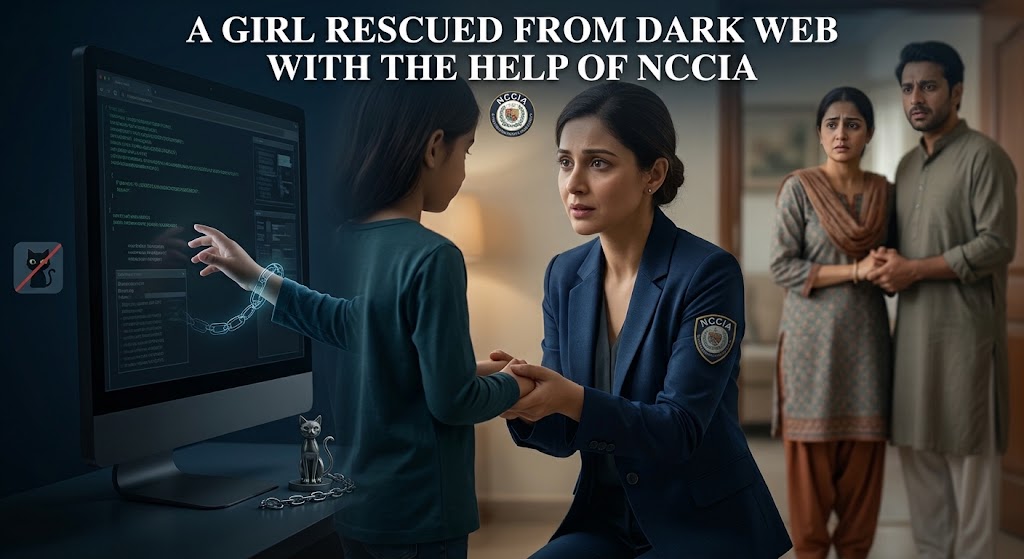
In Karachi, Pakistan a 13-year-old girl allegedly poisoned a cat to death and completed her first task. She was then given a second task: to harm herself. However, before she could complete the task, she was rescued. It was later discovered that the girl was being manipulated by a network that was assigning her tasks through the dark web.
All of this was happening while her parents remained unaware. They had noticed changes in their daughter's behavior but did not realize that she had already poisoned a cat and was about to carry out a task that could cause her serious harm.
This incident has raised a major question: Are our children using the internet, or is someone using the internet to manipulate our children?
NCCIA Intervention and International Intelligence
Officials from the National Cyber Crime Investigation Agency (NCCIA) say they rescued a 13-year-old girl in Karachi, Pakistan before she could harm herself. The girl had been in contact with an online group suspected of being part of a network allegedly linked to the dark web. According to the investigation, the girl was first instructed to poison a cat and was later encouraged to inflict harm on herself. However, the NCCIA intervened before she could act on the second task.
According to the NCCIA, the agency received information from an international intelligence agency, which provided Pakistani authorities with details about suspicious online activities and IP addresses associated with several countries. The international agency shared information about IP addresses used in 13 countries, including Pakistan.
The NCCIA then traced the IP address linked to Pakistan. During the investigation, officials discovered that the person associated with the IP address was not a suspect but a victim. Further inquiries revealed that the individual was a 13-year-old girl.
Investigation Findings and Behavioral Changes
According to the NCCIA, the girl's parents were unaware of her online activities and had no knowledge of her contact with the online network. During questioning, they explained that they had noticed changes in their daughter's behavior over the previous six months. However, they had not realized that these behavioral changes might be connected to her online activities.
NCCIA investigators are still attempting to trace the accounts through which the girl was contacted. Authorities are also investigating whether other children in Pakistan have been targeted through similar online activities.
Speaking to Geo News reporter Zeeshan Shah, NCCIA (Natiaonal Cyber Crime Investigation Agency) Karachi, Pakistan Additional Director Tahir Nawaz said that investigators had identified two to three additional affected individuals. The devices recovered from the girl are also undergoing forensic examination as part of the investigation.
Parental Awareness and Warning Signs
This incident raises several important questions. If a child's behavior begins to change, shouldn't parents investigate the reasons behind those changes? Parents should try to understand what is happening in their children's online lives, whom they are communicating with, and who is contacting them.
Key warning signs parents should look for include:
- Someone asking the child to keep online activities or chats secret.
- Unexplained emotional outbursts, withdrawal, or sudden behavioral shifts.
- Online threats or pressure to perform unusual, secret tasks.
- Instructions urging a child to endanger themselves or others.
Conclusion
Protecting children online requires continuous vigilance, effective digital safety education, and early intervention. For further updates on cybersecurity awareness and global current affairs, keep visiting www.jobsblogs.online.