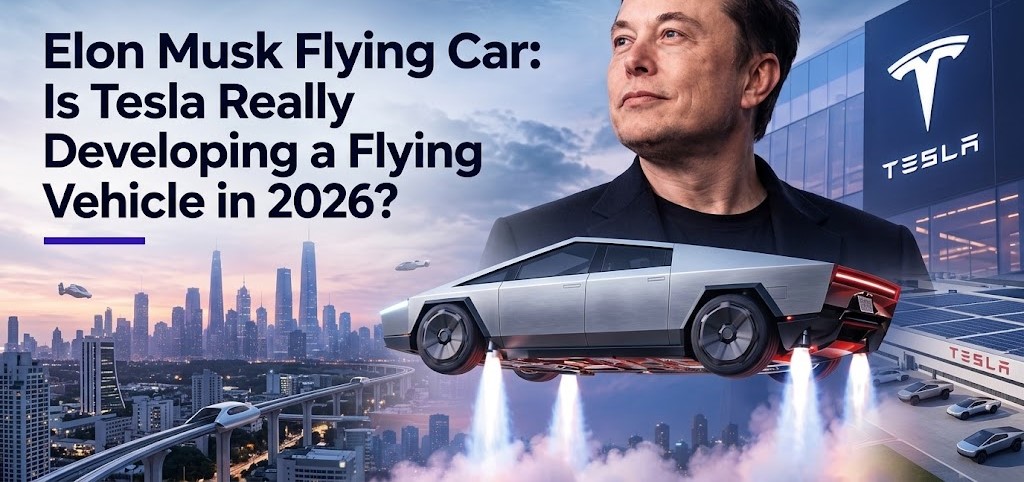
At a product reveal at a Texas test facility belonging to SpaceX, Musk’s other public company, he showed off Tesla’s new Roadster, a two-person sports car that not only could go from 0 to 60 mph in a record time of less than a second, but he said used suction underneath the car to climb up a steep ramp and hang upside down before spinning off the ramp, flipping in the air and using air jets to land.
The car did not have an actual driver during the demonstration, which was done “to make sure we don’t kill anyone,” Musk told the crowd.
“Success is not guaranteed,” he said. “I mean that. It’ll probably work, but if it doesn’t work, we’re at a safe distance.”
The Staged Demonstration & Rocket Tech
Later in Thursday’s demonstration, the Roadster used the same jets to leap over a line of Tesla’s existing models parked side by-side, and then used the jets off the back of the car to accelerate to 60 mph in that record time.
Musk told an enthusiastic crowd of Tesla fans “we need an audience to prove that it’s not AI or SI. So you guys can tell people you saw it with your eyes, because what you see with your eyes, you will not believe.”
The car uses 10 nozzles and what Musk described as “ultra high-pressure air tanks” to propel itself, both in the air and to accelerate quickly when on the ground. He described the technology as “the results of what happens when you have a collaboration with the world’s best car company and the world’s best rocket company.” He announced that the car will go into production in 2028.
Engineering Hurdles & Expert Skepticism
Even with the success of the staged event, whether the car will actually be able to live up to the promise and provide owners with the ability to fly rather than just hop, while also being able to drive very fast on roads, remains to be proven.
In recent years, there have been many advancements in electric vertical take-off and landing aircraft, known as eVTOLs. However, there are still many engineering roadblocks to road-worthy cars that can truly fly.
“Aircraft are extremely sensitive to weight, whereas with ground vehicles you want them to have bumpers and crumple zones and all that,” Roger Connor, curator for vertical flight at the Smithsonian’s National Air and Space Museum, noted. “Inevitably, something that is a hybrid between the two is going to be a poor performing aircraft and a poor performing vehicle, and also quite expensive.”
Ahead of Tesla’s demonstration, Alef CEO Jim Dukhovny noted that while getting a vehicle off the ground is feasible, the hardest part for all eVTOLs is transitioning smoothly from rising vertically to moving forward safely without losing lift.
Whether the Roadster is able to truly fly across cityscapes is very difficult to say, and current demonstrations point more toward vehicle "hopping" rather than sustained flight. For more tech innovations and global news, keep visiting www.jobsblogs.online.