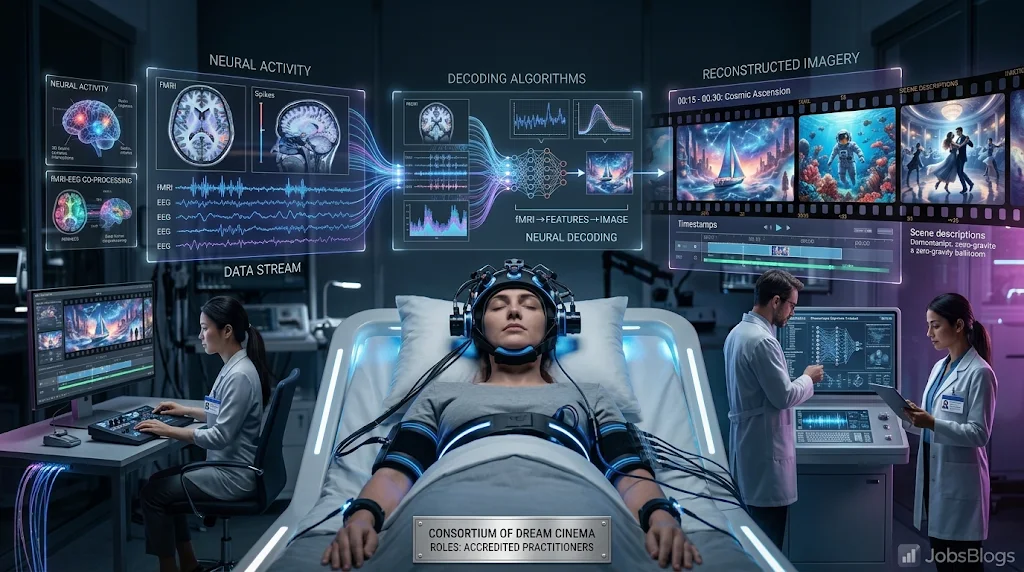
A story that keeps going viral says scientists in Japan have built a machine that can record your dreams and play them back for you to watch like a movie. The research behind it is real, and it is remarkable. The headline, however, goes much further than the science.
Researchers at ATR in Kyoto showed that a computer could predict, better than chance, which categories of objects, such as people or places, three volunteers were seeing in dream-like imagery as they fell asleep. They did not capture footage of a dream. Online reactions have been mixed, with some people excited to revisit their dreams and others uneasy about what it means for privacy.
What Did the Kyoto Researchers Actually Do?
The paper, "Neural Decoding of Visual Imagery During Sleep," was published in Science in 2013 by Horikawa, Tamaki, Miyawaki and Kamitani of ATR's neuroinformatics group. The experiment ran in five steps:
- Sleeping in a scanner. Three participants took turns sleeping inside an fMRI scanner, which tracks changes in blood flow in the brain, while EEG monitored their sleep stage. Sessions lasted about three hours and ran over roughly 10 days.
- Waking and asking. When EEG showed they had drifted into early sleep, researchers woke them and asked what they had just seen. This was repeated about 200 times per person.
- Sorting the reports. The team grouped what people described into about 20 object categories, such as people, places and everyday objects.
- Training on awake brains. While awake in the scanner, participants viewed web photos of those categories, so the system could learn each person's brain pattern for each category.
- Testing on sleep. The trained decoder was then tested on brain activity recorded just before each awakening, to see whether it could predict what the person had reported.
The Viral Claim vs. What the Study Found
| Viral claim | What the research shows |
|---|---|
| "Records your dreams" | The decoder predicted which of about 20 object categories a person had reported. It did not capture the dream itself. |
| "Plays them back like a movie" | There was no film. Snopes rates the claim a "Mixture" and says the output was not a narrative video of a dream. |
| "Early REM sleep" | Participants were woken during sleep onset, in light sleep, not REM. |
| "Participants confirmed a 60% match with the video" | The 60% figure is the decoder's accuracy when choosing between two categories, not a viewer rating of a video. |
| "A new invention" | The study dates from 2013 and has been recycled in viral posts many times since. |
| "Three participants" | Correct. That small sample is one of the study's main limits. |
What Does the 60% Accuracy Figure Mean?
For each test, the researchers picked two categories: one the dreamer had reported and one they had not. When the decoder identified one of them, it chose the correct one about 60% of the time. Random guessing in a two-way choice would be right 50% of the time, and the researchers said the 60% result could not be explained by chance.
That is a real scientific result, but a modest one. The decoder was better at telling broad categories apart, such as a person versus a scene, than at telling specific images within a category apart. It also worked only with the preset categories, and only in three people.
✅ What the study showed
- Brain activity in early sleep carries information about the kinds of objects people report seeing
- A decoder trained on awake viewing could predict reported categories better than chance
- Each person's brain pattern for an object was similar awake and asleep
❌ What it did not show
- Recording or replaying a dream as video
- Decoding the long, vivid dreams of REM sleep
- Reconstructing specific images from a sleeping brain
- Reading anyone's dreams without a scanner and that person's own training data
- Results from more than three people
What Has Happened Since 2013?
| When | Development |
|---|---|
| 2013 | The Kyoto team publishes the dream-decoding study in Science. |
| 2017 | The same lab publishes a follow-up in Frontiers in Computational Neuroscience with two participants. It links dream reports to features from a deep neural network and identifies dreamed objects above chance, but it does not reconstruct images. |
| Oct 2023 | A popular article repeats the movie-playback framing and the 60% figure as a participant rating. |
| Jan 2024 | Snopes reports that the study's lead author said there had been little progress on dreams specifically. The team's image-reconstruction method had improved, and they were testing whether it could reflect dream content. |
| Oct 2026 | Israel's Weizmann Institute reports Brain-IT, an AI that reconstructs images people are viewing while awake from fMRI scans. Its lead researcher says decoding dreams or imagined scenes is a goal, not yet achieved. |
Is Dream Decoding a Privacy Risk?
The idea of a machine reading dreams unsettles many people, and the concern is fair to raise. For now, the practical limits are large. The published methods need a cooperative person lying still inside an fMRI scanner, and the decoder was trained on that person's own brain activity while awake. Snopes also notes that brain patterns for the same object differ between individuals.
Researchers say they are exploring simpler tools such as EEG, which uses scalp electrodes. If brain-decoding technology becomes cheaper and easier to use, questions about consent and mental privacy will matter more, so the debate is likely to continue.
Frequently Asked Questions
Can scientists record dreams and play them back like a movie?
Who ran the Kyoto dream-decoding study?
What does the 60% accuracy figure mean?
Was the study done during REM sleep?
How many people took part in the study?
Is this a new invention?
Can AI read my dreams today?
Is dream decoding a privacy risk?
Sources
- Neural Decoding of Visual Imagery During Sleep, ATR Kamitani Group (research page)
- Scientists Figure Out What You See While You're Dreaming, Smithsonian Magazine
- Fact check: Japanese scientists and an MRI machine that records dreams, Snopes
- Hierarchical Neural Representation of Dreamed Objects Revealed by Brain Decoding with Deep Neural Network Features, Frontiers in Computational Neuroscience (2017)
- This AI Reconstructs What You're Looking at From a Brain Scan, Singularity Hub (Oct 2026)
- Example of the viral framing: "Researchers Created a Machine That Can Record Your Dreams…", YourTango (Oct 2023)
For ongoing verified news updates and global current affairs, keep visiting www.jobsblogs.online.