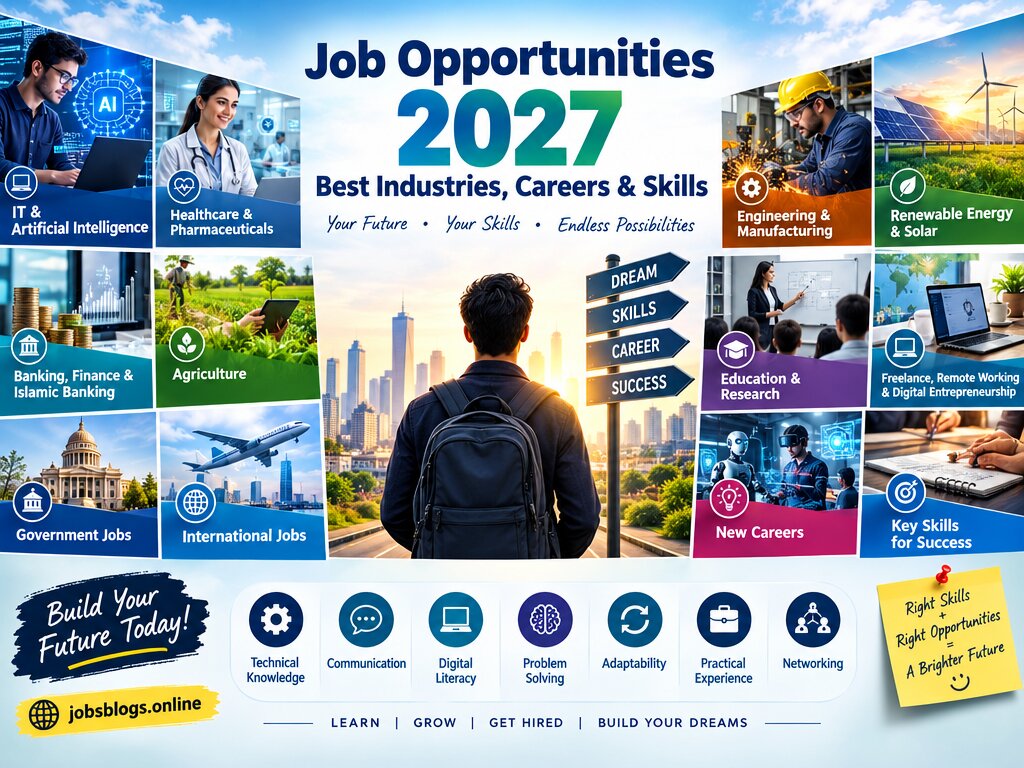
Job market is changing rapidly due to new technologies, industrial developments and economic factors with lots of new graduates coming into the workforce every year. Many experienced professionals are also looking for better jobs. While there are issues with unemployment and economic factors, there are still many industries offering good career opportunities.
Careers in IT, Healthcare, Engineering, Manufacturing, Renewable Energy, Banking, Agriculture, Education and Digital Entrepreneurship. With the increase in freelancing, remote working and overseas roles.
1. Information Technology & Artificial Intelligence
One of the best is Information Technology. As businesses move into using digital technology, software, online solutions and automation, there is now a need for people to develop this technology.
There was also an increase in technology freelancing exports.
Careers in:
- Software Development
- WEB Development
- Mobile Applications
- Artificial Intelligence & Machine Learning
- DATA Science & Business Analytics
- CYBER Security & Network Administration
- CLOUD Computing & Database Management
- Digital Marketing & Search Engine Optimisation
Artificial Intelligence is becoming increasingly important due to many businesses looking to implement AI based solutions. To begin with, students can learn programming languages like Python, maths and analytical skills. Then put them into practice.
While having a degree from university can give you a great foundation, having practical skills will help you get hired. Try getting some professional certifications, online courses, internships and a portfolio.
2. Healthcare & Pharmaceuticals
Healthcare is an important career. Hospitals, diagnostic labs, pharmaceuticals, clinics and Research Facilities all need skilled professionals.
Careers in healthcare are not just limited to Doctors and Nurses. Medical lab technologists, Pharmacists, Radiographers, Physiotherapists, biomedical engineers, health care administrators and biotech researchers are also in demand.
The Pharmaceutical industry also offering great opportunities for Chemists, Pharmacists, Biotech and Chemical Engineers. There are jobs in pharmaceutical manufacturing, quality assurance, quality control, research and development, regulatory affairs and production management.
Due to the increase in diagnostic equipment and digital healthcare, there will be a need for someone with knowledge in both medical science and technology. Choose a recognised course and ensure you have the correct professional certifications.
Practical skills, communication and ethics are very important in healthcare as you will be working with patients, medical equipment and sensitive information.
3. Engineering & Manufacturing
Engineering and manufacturing play a key role. These industries need professionals to design products, run machinery, improve processes and ensure quality.
Main industries include Textiles, Cement, Chemicals, Pharmaceuticals, Automobiles, Steel, Plastics and Food Processing.
Careers in:
- Mechanical Engineer
- Electrical Engineer
- Civil Engineer
- Chemical Engineer
- Industrial Engineer
- Materials Science
- Metallurgy
- Production Management
Quality Control Technicians, Maintenance Engineers, Process Operators, Instrumentation Technicians and Safety Professionals are also hired by manufacturing companies. If you have technical skills in welding, machining, fabrication, electrical installation and industrial maintenance then there are many vocational and industrial roles.
Having an engineering degree will help you gain jobs if you do an Industrial internship, practical lab work, technical software courses and understand safety standards in the workplace.
4. Renewable Energy & Solar
Renewable energy is becoming a key area to work worldwide. With rising energy costs, many households, businesses and industries are looking to switch to alternative energy sources.
Solar energy is offering many opportunities. Installers, electrical engineers, maintenance technicians, auditors and project managers are in demand.
Careers in:
- Solar Photovoltaic Designer
- Solar Installer
- Electrical Engineer
- Battery Specialist
- Power Electronics Engineer
- Renewable Energy Consultant
Energy storage is also offering many opportunities. Lithium battery specialists, battery management systems, electrical components and energy efficiency are all in demand.
If you have electrical, electronic and mechanical background there are many opportunities in this industry. Having technical knowledge in installing solar panels, inverters, electrical safety, battery wiring and maintenance will improve your employability.
As renewable energy moves forward, having trained technicians and engineers will be key to ensure reliable energy systems are installed.
5. Banking, Finance & Islamic Banking
Opportunities in the banking and finance industry for those with a degree in Finance, Accounting, Economics, Commerce, Business Administration and Information Technology.
Commercial Banks, Islamic Banks, Microfinance, Insurance and Financial Technology all hire professionals.
Careers in:
- Banking Officer
- Credit Analyst
- Financial Analyst
- Accountant
- Auditor
- Compliance Officer
- Risk Management
- Customer Relationship Manager
Islamic Banking is an important area to develop your career. It uses Shariah law and financial solutions like Murabaha, Ijarah, Musharakah and Mudarabah. If you are interested in this industry you can study Islamic Finance. Alongside accounting, finance or business administration.
Due to the changes in banking, digital banking, mobile payments and finance technology there may be opportunities for those with finance and technical knowledge.
6. Agriculture
Agriculture is a large industry offering many jobs, there are many modern opportunities in agriculture: new technology, food processing, research and supply chain management.
Careers in:
- Agricultural Engineer
- Agronomist
- Food Science
- Food Technology
- Agricultural Biotechnology
- Livestock Management
- Soil Science
- Water Resource Management
Food processing companies need professionals to improve processes, packaging, storage, quality and food safety. Those with a degree in Chemistry, Biotechnology, Microbiology, Food Science & Engineering can look into Food Manufacturing, Research Facilities, Agriculture Companies & Quality Control Labs.
The future of this industry will depend on water efficiency, improved crops, automation, adapting to climate change and modern food processing. Young professionals who understand these challenges can help improve productivity.
7. Education & Research
There are many education opportunities in schools, colleges, universities, research facilities and private education. Teachers, Lecturers, Researchers, Academic Administrators & Education Consultants play an important role in developing human resources.
Careers in:
- School Teacher
- College Lecturer
- University Researcher
- Academic Administrator
- Online Tutor
- Curriculum Development
- Education Consultant
Those wanting to teach and research at university level can look into Postgraduate qualifications. Those looking into research can look into laboratories, Industrial Research Centres & International Academic Collaborations.
With online education, there are many opportunities for Subject Specialists to tutor, create online courses and produce educational material.
To be a successful educator you will need good subject knowledge, communication, presentation and knowledge of modern teaching methods.
8. Freelance, Remote Working & Digital Entrepreneurship
Many professionals are looking into Freelance roles worldwide. This gives you the opportunity to provide services to clients.
Popular Freelance Jobs include Website Developers, Graphic Designers, Video Editors, Content Writers, Translators, Digital Marketers, Data Analysts, Virtual Assistants & E-Commerce Management.
Freelancing can be quite competitive and the income can be unpredictable, especially if you are new to it. The best way to start is by focusing on one service you would like to provide. Gain the skills needed, create example projects and build a portfolio.
Another option is to become a Digital Entrepreneur. Start your own online store, education platform, Digital Service Agency or specialised website. Before you invest any money, research what the customer needs, competitors, pricing and running costs.
Building trust with customers, providing a consistent service and good communication will help you build a sustainable business.
9. Government Jobs
Many people interested in working in government roles. Usually there are clear processes for hiring and the roles can offer a clear career path.
Jobs will be advertised by Federal & Provincial Departments, Public Service Commissions, Education and Public Sector.
Key hiring bodies include the Federal Public Service Commission, Punjab Public Service Commission, Sindh Public Service Commission, Khyber Pakhtunkhwa Public Service Commission & Balochistan Public Service Commission.
Careers in:
- Administration
- Education
- Healthcare
- Engineering
- Finance
- Research
- Technical
Carefully read through the adverts to see what qualifications you need, age restrictions, experience, deadlines and exams. As this can be very competitive consider looking into the private sector, internships and training.
10. International Jobs
There are many opportunities for professionals and skilled workers to work internationally. Countries in the Gulf region, Europe, North America and other international locations are hiring for Healthcare, Engineering, Construction, Information Technology, Manufacturing, Transport & Hospitality.
Common roles include Nurses, Engineers, Electricians, Welders, Construction Supervisors, Software Developers, Drivers & Hospitality.
Create a professional CV and ensure your qualifications are verified. Check if your job requires any licensing or certification.
Ensure you read through the employment contract. Use licensed overseas employment promoters. Be cautious of any suspicious agents, unrealistic salary expectations and requests for upfront payments.
Academics can look into International Universities, Research facilities, Doctorates & Post Doctorates.
11. New Careers
Alongside traditional careers there are many new careers coming up. Businesses are moving into advanced technology and modern methods.
AI Specialists are becoming more relevant as businesses look to implement automation. Cyber Security Analysts help protect digital systems and sensitive information. Cloud Computing Engineers manage online systems and Data Analysts help organisations make informed decisions.
Other new careers include Electric Vehicle Technicians, Battery Specialists, Robotics Technicians, Semiconductor Design Specialist, Environmental Consultant & Supply Chain Data Analyst.
As digital healthcare, precision agriculture, renewable energy and automation develops there could be specialist roles.
However, just because it is a new career doesn’t mean it will guarantee you a job. Research what employers actually need, training available and whether there will be a long-term demand for your specialisation.
12. Key Skills for Success
While having an academic qualification is important, employers are looking for practical skills.
- Technical Knowledge: Ensure you have knowledge and practical skills in your chosen career.
- Communication: Improve your English, professional writing, presentation and teamwork.
- Digital Literacy: Learn how to use computers, modern software, online teamwork and relevant AI.
- Problem Solving: Employers want people that can analyse problems, make informed decisions and complete tasks independently.
- Adaptability: Technology and business are constantly changing so you need a willingness to learn new methods.
- Practical Experience: Internships, Apprenticeships, Supervised Projects & Industrial Training.
- Networking: Use LinkedIn, Career Fairs, Academic Conferences & Industry Events.
The National Vocational & Technical Training Commission (NAVTTC) will have information on vocational training. Check official announcements to see what courses are available and what you will need to qualify.
13. Tips for Fresh Graduates
Getting your first job can be challenging as many employers look for someone with experience. However, there are ways to improve your chances.
Make a clear and professional CV. Highlight your education, technical skills, internships, research projects and relevant achievements. Don’t include unnecessary personal information and tailor your CV to the job you are applying for.
Create a professional LinkedIn profile. Connect with recruiters, employers and professionals in your desired industry.
Apply for Internships, trainee roles and entry-level roles. This will give you practical experience and show you what to expect in the workplace.
Complete relevant training and build a portfolio.
Prepare well for interviews. Research the company, understand the job description and practice explaining how your skills match the employer’s needs.
Your first job may not pay well but gaining useful experience, developing professionally and consistently performing will create better opportunities in the future.